
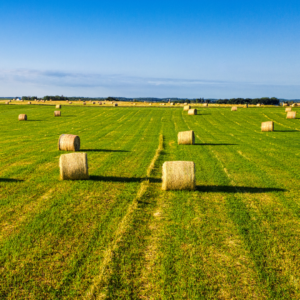
 Knowing exactly when and how to fertilize hay fields in Georgia is the key to unlocking maximum yield and superior quality forage. As the last hints of winter fade and the Georgia landscape begins to stir, March signals a critical turning point for hay farmers. The warming soil and longer days mean it’s time to wake up your dormant fields and set the stage for a bountiful harvest season. One of the most important tasks on this March checklist is fertilization. J & J Farms can provide expert advice and high-quality hay for you.
Our guide will walk you through the essentials of spring hay fertilization. We’ll cover the importance of timing, the necessity of soil testing, how to choose the right nutrients, and the direct impact these steps have on your hay production. Proper preparation now will pay dividends all season long.
Why March is a Crucial Month for Hay Field Care
Timing is everything in farming. For warm-season grasses like Bermuda grass and Bahia grass, which are the backbone of Georgia hay production, early spring is the prime time for care. Fertilizing too early, when the ground is still cold, means the grass isn’t ready to use the nutrients, leading to wasted money and potential environmental runoff. Fertilizing too late can miss the critical initial growth phase, resulting in a weaker first cutting.
March represents the sweet spot. As soil temperatures consistently rise to around 60-65°F, these grasses begin to break dormancy and “green up.” This is the signal that the root systems are becoming active and are ready to absorb the nutrients you provide. Applying fertilizer during this window gives your fields the fuel they need for vigorous spring growth, ensuring a strong start to the hay season.
Step One: Don’t Guess, Soil Test
Before you purchase a single bag of fertilizer, the first and most critical step is to conduct a soil test. Fertilizing without a soil test is like taking medication without a diagnosis—you might be doing more harm than good. Georgia’s soils can vary significantly in pH and nutrient levels, and a test provides a precise roadmap for what your specific field needs. Our flagship store, Cherokee Feed, offers free hay & forage testing services.
A soil test reveals two vital pieces of information:
- Soil pH: This measures the acidity or alkalinity of your soil. Most hay grasses in Georgia thrive in a pH range of 6.0 to 6.5. If your soil is too acidic (a common issue in the state), the grass cannot effectively absorb nutrients, no matter how much fertilizer you apply. A soil test will tell you if you need to apply lime to raise the pH, a process that should ideally be done several months before fertilization for the best results.
- Nutrient Levels: The test will show the current levels of essential macronutrients: nitrogen (N), phosphorus (P), and potassium (K). It will also provide recommendations for how much of each nutrient to apply to achieve optimal growth for your specific type of hay.
You can get soil testing kits and analysis from your local University of Georgia (UGA) Extension office. Taking this simple step can save you hundreds of dollars in unnecessary fertilizer and dramatically improve your hay yield.
Choosing the Right Fertilizer for Georgia Fields
Once you have your soil test results, you can confidently select the right fertilizer blend. The three numbers on a fertilizer bag (e.g., 17-17-17 or 34-0-0) represent the percentage of N-P-K. Your soil test will guide you to the correct ratio for your fields.
- Nitrogen (N): This is the primary driver of vegetative growth and gives hay its deep green color. It is the nutrient most responsible for increasing yield. A spring application gives the grass the energy it needs for its initial growth spurt.
- Phosphorus (P): Crucial for strong root development and energy transfer within the plant. Healthy roots are essential for nutrient uptake and drought tolerance later in the season.
- Potassium (K): Often called the “health” nutrient, potassium helps regulate the plant’s internal processes, improves disease resistance, and strengthens cell walls. It is vital for overall plant vigor and resilience. Forage grasses remove large amounts of potassium from the soil with each cutting, so replenishing it is essential for long-term field health.
For established warm-season grasses like Bermuda, a common spring hay fertilization strategy involves applying a complete fertilizer (containing N, P, and K) after green-up, based on your soil test. This initial application sets the foundation for the entire growing season.
Application Timing and Methods
For your March hay field care, wait until the grass has shown consistent signs of greening up. Applying fertilizer to a fully dormant field is inefficient.
- Wait for Green-Up: Look for about 50-75% green-up across the field. This indicates the plant is actively growing and ready for nutrients.
- Consider the Weather: The ideal time to apply fertilizer is just before a light rain. The rain will help move the nutrients into the soil and down to the root zone. Avoid fertilizing before a heavy downpour, as this can wash the fertilizer away.
- Weed Control: Early spring is also the time to manage weeds. Many farmers apply both fertilizer and pre-emergent or post-emergent herbicides. Be sure to read the labels carefully to ensure the products are compatible and appropriate for your type of hay. Some herbicides have grazing or harvesting restrictions that you must follow.
The Payoff: Higher Yield and Better Quality
Properly fertilizing hay fields in Georgia does more than just make the grass grow. It directly translates to a more profitable and sustainable operation.
- Increased Yield: A well-fed field produces more tons of hay per acre. By providing the necessary nutrients in March, you maximize the potential of your first and most important cutting of the year.
- Higher Nutritional Value: Nutrient-rich soil leads to nutrient-rich forage. Properly fertilized hay has higher protein content and is more palatable to livestock, which is crucial for animal health and performance.
- Better Field Longevity: Consistently applying the right nutrients based on soil tests maintains the health and productivity of your hay stand for years. It prevents the soil from becoming depleted, which can lead to thinning grass, weed infestation, and declining yields.
Prepare for a Productive Season
March is the month of action. Don’t let this critical window pass you by. Take the time now to get your soil tested, create a fertilization plan, and give your fields the attention they deserve. These Georgia hay farming tips will help you lay the groundwork for a successful and productive hay season.