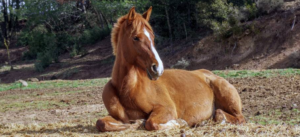
 Out of Work Horses: Management Strategies. How can you safely shift a horse from near-daily exercise to a life of leisure, even if temporary? Appropriate nutrition is a key consideration during this transition.
Moving from stall to pasture:
Has your horse been kept in the barn all or most of the time while actively training and showing? Make the switch to pasture gradually. Start with half an hour of grazing two or three times a day. Make sure to provide plenty of hay when the horse is in the stall. Increase pasture time in half-hour increments for several days. Next, add an hour or two to each grazing session until the horse is able to be out all the time.
The horse’s digestive system is complex. Any horse relocated abruptly from stall to full pasture is at high risk for colic or laminitis. At any time during the shift, if the hooves feel warm to the touch, or the horse shows signs of pain or reluctance to move, put the horse in the stall and contact your veterinarian immediately.
Some horses are so sensitive to the sugars in grass that they can never have unlimited access to pasture. These equines can still benefit from a few weeks or months of full or partial turnout if they are muzzled or placed in a drylot with an adequate supply of hay.
Feeding:
To stay in show condition and perform the work he has been asked to do, your horse has probably been given top-quality hay and one or more feedings of concentrate (pellets or sweet feed) daily. Without the demands of training, he will require the same basic nutrients but will need much less energy. Ideally, you can take a week or two to taper his schedule, slowly decreasing both his work and his grain ration.
Gradually switching to a balancer pellet or a vitamin and mineral supplement will supply essential nutrients without the calories found in a concentrated feed. Kentucky Equine Research has developed several vitamin and mineral supplements. Continue to give your horse whatever dietary supplements he is accustomed to, such as hoof and joint products, but check ingredients to avoid over supplementation when feeding more than one product.
You should still provide hay whenever the horse spends time in the stall. Something to munch on will alleviate boredom, keep gastric ulcers at bay, and prevent gorging on grass at the next turn-out. Free-choice access to water and salt is essential at all times.
Pasture safety:
Before turning your horse out the first time, take a quick tour of the fenceline and field to check for debris, holes, loose boards or wire, and insecure gate latches, and correct any problems before using the field. Bell boots and galloping boots can help guard against injury as the horse gets used to his freedom.
Depending on the season, fly spray will give a few hours of relief from insects; consider using mesh fly sheets, face masks, and leg covers for longer-lasting comfort. Changing seasons may eliminate insect problems, but horses with white faces may need sun protection year-round. Sunscreen or fly masks with muzzle extensions can prevent painful sunburn.
Hoof care:
Many people feel it is advantageous for horses to go barefoot if they are going to be inactive for several months. Will your horse benefit from having his shoes pulled? Consider these things as you make this decision.
- Horses that are newly barefoot will probably be somewhat tender for a week or so until the soles begin to toughen. If possible, turn out in a field with grass or dirt rather than a rocky area. Pasture the horse with amiable companions to avoid forcing him to run or kick to defend himself.
- Hoof shape will change without the support of a shoe. Probable changes include spreading of the heel, flaring in the quarters, and chipping at the toe and sides of the hoof. These changes are normal. Unless they are excessive, they’re nothing to worry about.
- Whether the horse is shod or barefoot, basic hoof care should not change when the horse is out of work. Hooves should be inspected and picked at least daily, and the schedule of farrier visits should be maintained. Toes tend to grow faster than quarters and heels. Going more than about six weeks between trimmings can change the angle of the pastern. This can lead to unnecessary strain on the tendons and ligaments in the lower leg.
- Horses that have therapeutic shoeing for navicular syndrome, laminitis, or other hoof problems may need to remain shod. Discuss with your farrier whether to leave the idle horse shod. In addition to remove only the rear shoes, or to pull all the shoes until the horse returns to work.
- Maintain horses on a high-quality hoof supplement, if necessary.
Other management:
Even though he is not working, your horse still needs daily attention. A light grooming gives you a chance to find and treat injuries or skin conditions. For example, dew poisoning or rain rot. Face masks and grazing muzzles should be removed at least once a day to check for rubbed areas. A regular schedule of deworming, vaccinations, and dental care should be followed just as though the horse were still in training.
In conclusion, do you have a specific question about Out of Work Horses: Management Strategies? Contact J & J Hay Farms today at 770-887-0440!
Article Source: Kentucky Equine Research
 What Is the Effect of Restricted Hay Intake Before Exercise in Horses? The goal of this study was to compare ad libitum and restricted (1% of body weight for a three-day period) hay intake on metabolic responses of Thoroughbreds. They were subjected to high-intensity exercise.
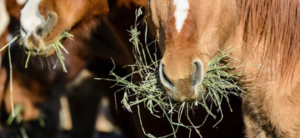 Steaming Hay One Component of Managing Equine Asthma: According to one recent study*,
 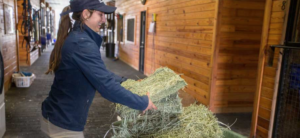 How Much Hay To Feed Horses: Where To Begin. Horses thrive on diets rife with forages, whether it is a medley of pasture grasses, baled hay, or another forage product, such as hay cubes, hay pellets, or haylage. They are capable of processing huge quantities of forage to meet their nutritional demands, but where does a horse owner start in determining how much forage to feed?
 Electrolytes and Muscle Function: What’s the Connection? Electrolytes are necessary for normal muscle contraction and relaxation. “When electrolytes become depleted or imbalanced, fatigue and muscle cramps can result,” says Catherine Whitehouse, M.S., a nutritionist with Kentucky Equine Research (KER).
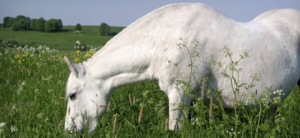 Starch and Inflammation: Considerations for Old and Overweight Horses. Body-wide inflammation contributes to the development of acute and chronic diseases in horses such as laminitis or metabolic syndrome. High-starch meals appear to induce inflammatory responses in certain young, old, and overweight horses. However, at differing time points and severities.
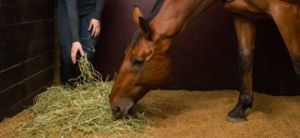 Hay for Horses: A Question of Quality. Ask horse owners to describe a perfect flake of hay, and the diversity of responses may astonish. The owner of a plus-size pony may mention a blend of local pasture grasses, sweet-smelling and pillowy to the touch; another might specify densely packed alfalfa, bright green and laden with leaves. A third owner may extol the nutritional virtues of early-maturing timothy, with its long blades and barely-there seed heads.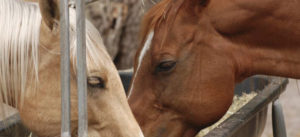
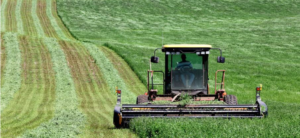 Rhizoma Peanut Hay for Horses: When horsemen think of legume hay, alfalfa invariably springs to mind with clover or lespedeza as possible runners-up. Few people probably think of rhizoma peanut (Arachis glabrata Benth), a warm-season perennial legume. While rhizoma peanut gets high marks for productivity and persistence in varying management and environmental conditions, how does it stack up nutritionally against alfalfa, the long-revered gold standard of legumes for horses?