 An age-old question: when is feeding old hay to horses O.K.?
Hay doesn’t come stamped with an expiration date. Sometimes it’s hard to know when to use it and when to toss it. Consider these points:
- If the hay was of good-quality when harvested and stored in a dry place with sufficient airflow, hay is likely suitable for consumption for two to three years.
- Keep in mind that hay, even premium forage, loses much of its vitamin content in the first few months of storage. “Hay stored in hot environments, such as haylofts, can lose half to three-quarters of its vitamin E content over a three-month period,” said Kathleen Crandell, Ph.D., nutritionist with Kentucky Equine Research (KER).
- Do not expect two- or three-year-old hay to contribute significantly to vitamin A nutrition. “About 75% of vitamin A disappears within the first 24 hours of cutting and then loses another 10% monthly. Because forage is rich in vitamin A, this is not a concern for hay fed in the first year or so following harvesting,” said Crandell.
- Because vitamin D is more stable than vitamins A and E, hay loses very little of vitamin D in storage, according to Crandell.
What’s the best way to handle nutrient deficiencies if old hay is fed?
If horses are consuming green pasture and a well-fortified concentrate, there is no need to worry about the vitamin and mineral content of whatever old, well-preserved hay horses may be nibbling on. If, however, the hay is fed as the sole feedstuff, changes to the diet should be considered, as the horse will not be consuming sufficient vitamins and minerals for top-notch health.
One of three feeding scenarios usually unfolds:
- A fortified concentrate should be fed if horses require additional calories on top of the hay to maintain body weight. Feeds are available for every life stage, and an appropriate one should be purchased and fed according to the manufacturer’s instructions. This might be the case with horses that are in moderate to heavy work and horses known to be hard keepers.
- If horses hold optimal body condition on hay alone and do not have elevated protein requirements (such as mature horses at maintenance or those light work), a vitamin and mineral supplement such as Micro-Max from KER would be appropriate. In Australia, look for Gold Pellet or Nutrequin SE.
- If horses require protein as well as minerals and vitamins for optimal health and performance, which is usually the case with easy keepers who serve as broodmares (barren or early gestation) or riding horses in near-daily work, consider feeding a balancer pellet.
Under no circumstances should old hay be fed if it has been compromised by dust, moisture, mold, or foreign objects. Undisturbed hay may also have been infiltrated by nesting rodents or wildlife. If raccoons, opossums, or rodents have run amuck in the loft, consider chucking the hay, as it could harbor disease-causing organisms, including those that cause equine protozoal myeloencephalitis (EPM).
Would you like more information about hay diets? Contact us at J & J Farms by clicking here!
Article brought to you by KER.
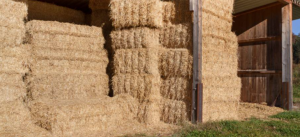 Cultivating good-quality hay is no easy task and is dependent on cooperative weather for optimal success. Hay farmers must keep a keen eye on plant growth, the moisture content at harvest, and other baling considerations in order to avoid moldy hay for horses. Mold forms on hay because of excessive moisture, which is why it is so critical to harvest hay under the most conducive conditions and then store it properly once baled.
 As autumn shifts to winter, or summer droughts begin to set in, horse owners in many climates must provide horses with an appropriate alternative forage to fulfill fiber requirements. In most cases, this involves switching to hay, haylage, or hay cubes.